Competition
Finalists

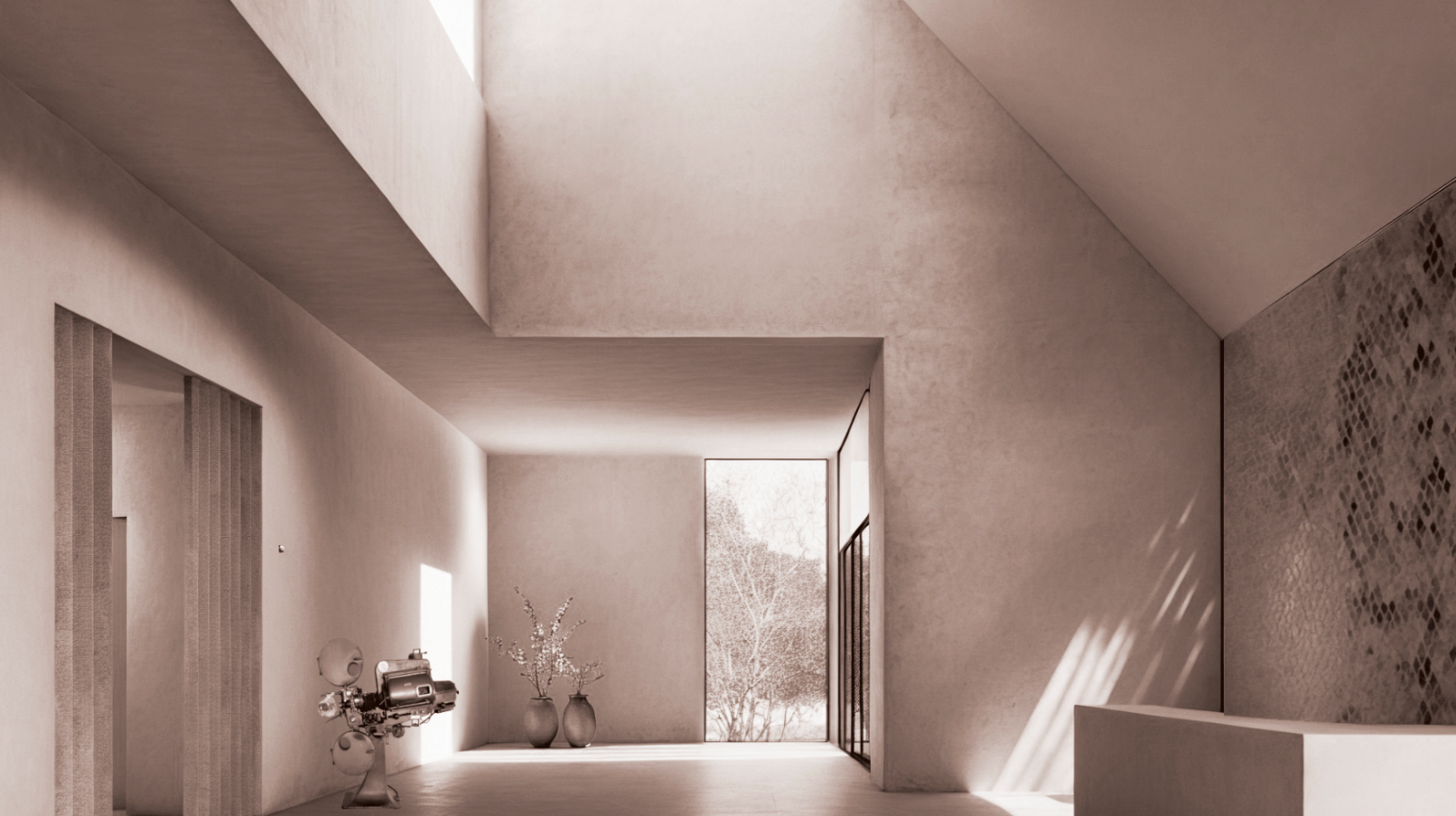
Cinema Pego
Date
2025
Location
Pego, Alicante
Direction and authorship / Elena Vilches Álvarez y David Moreno Rangel
Enmedio collaborators/ Carlos Macías, Encarna Márquez, Jara Sánchez, Álvaro Velasco, Fabio Pirsljin
Environmental consultant / Enmedio Studio
Client / Pego County Hall
CINEMATOGRAPHY f. (RAE) ‘Capture and projection of moving photographic images onto a screen’.
Cinematography transcends its definition; it is the universal language of emotions, capable of the infinite creation of stories, as infinite as the human imagination.
CINEMATOGRAPH m. (RAE) ‘Machine that allowed the recording or projection of films’
The cinematograph was that magic box where light and shadow danced, releasing countless stories that came to life when projected onto a screen.
Concept. ‘Cinema Pego’ was conceived to help bring the town to life. The cinema is that magical box that hosts multitude of cultural activities unique to its inhabitants, emphasizing local identity and the essence of Pego. That’s why the new building is designed to accommodate these stories. Architecture at the service of the town: welcome to ‘Cinema Pego’.
The proposal is based on three pillars:
– Maximum flexibility of use to accommodate diverse experiences, thanks to strategies such as the installation of two retractable seating sections in the main auditorium hall.
– Easy construction and cost-effectiveness.
– Integrated bioclimatic design to achieve zero-energy building status without impacting costs.
Adaptation of the surroundings. The new proposal maintains the essence of the original cinema, keeping the main entrance on Plaça del Mercat, but also allowing access from Carrer Sant Rafael. To widen the entrance from Plaça del Mercat, the sidewalk alignment is modified, creating a small plaza that alleviates crowding and even allows the placement of tables served by the new cultural space’s own bar. New trees are also planned to provide shade.
Construction systems. The aim is not to create a completely new center but rather a symbolic link to the past: therefore, locally sourced ceramics (from artisan workshops in Orba) and clay textures that revive the region’s building traditions and aesthetics will be used. Where possible, original elements from the old cinema will be recovered or reinterpreted—posters, color details, seat shapes, etc.—and information panels or photographs will be installed to recall the history of the place, allowing residents to reconnect with its past splendor.
It is considered a modular and industrialized construction system that is easy to assemble and disassemble. The building envelope and cladding (and even some structural components) are constructed as a single unit, improving construction times compared to typical administrative buildings and achieving (at the same cost) truly excellent levels of static and dynamic thermal performance. The structure is based on metal frames and composite steel decking, complemented by an ultralight industrialized cladding system. This system features a steel frame substructure with embedded rock wool insulation and ThermoChip TFbcY sandwich panels on the exterior. This system significantly simplifies construction in a consolidated urban context where adjacent streets are narrow.
Zero-energy building. To achieve this goal, a series of passive strategies have been implemented to take advantage of the area’s favorable climate. They also provide comfort for as many hours as possible throughout the year. These include:
– The chimney-shaped ventilation section in the lobby, in order to promote natural ventilation.
– A robust and airtight building envelope.
– The use of solar shading in the form of awnings and louvers.
The use of aerothermal heating and cooling provides high efficiency and low energy consumption, and the planned installation of 129 high-performance photovoltaic panels on the roof will further the zero-energy building objective. Strategies have been implemented that even allow the building to achieve environmental certifications.