Competition

Revitalization of A Tineria neighbourhood, Lugo
Date
2025
Location
Lugo, Galicia
Direction and authorship / Elena Vilches Álvarez and David Moreno Rangel
Enmedio collaborators/ Álvaro Velasco, Encarna Márquez, Jara Sánchez
Environmental consultant / Enmedio Studio
Facilities and structure consultant / Grupo Argenia
Client / Instituto Galego de Vivenda e Solo (IGVS)
Senda: a route built for travel, a procedure or means to do or achieve something…
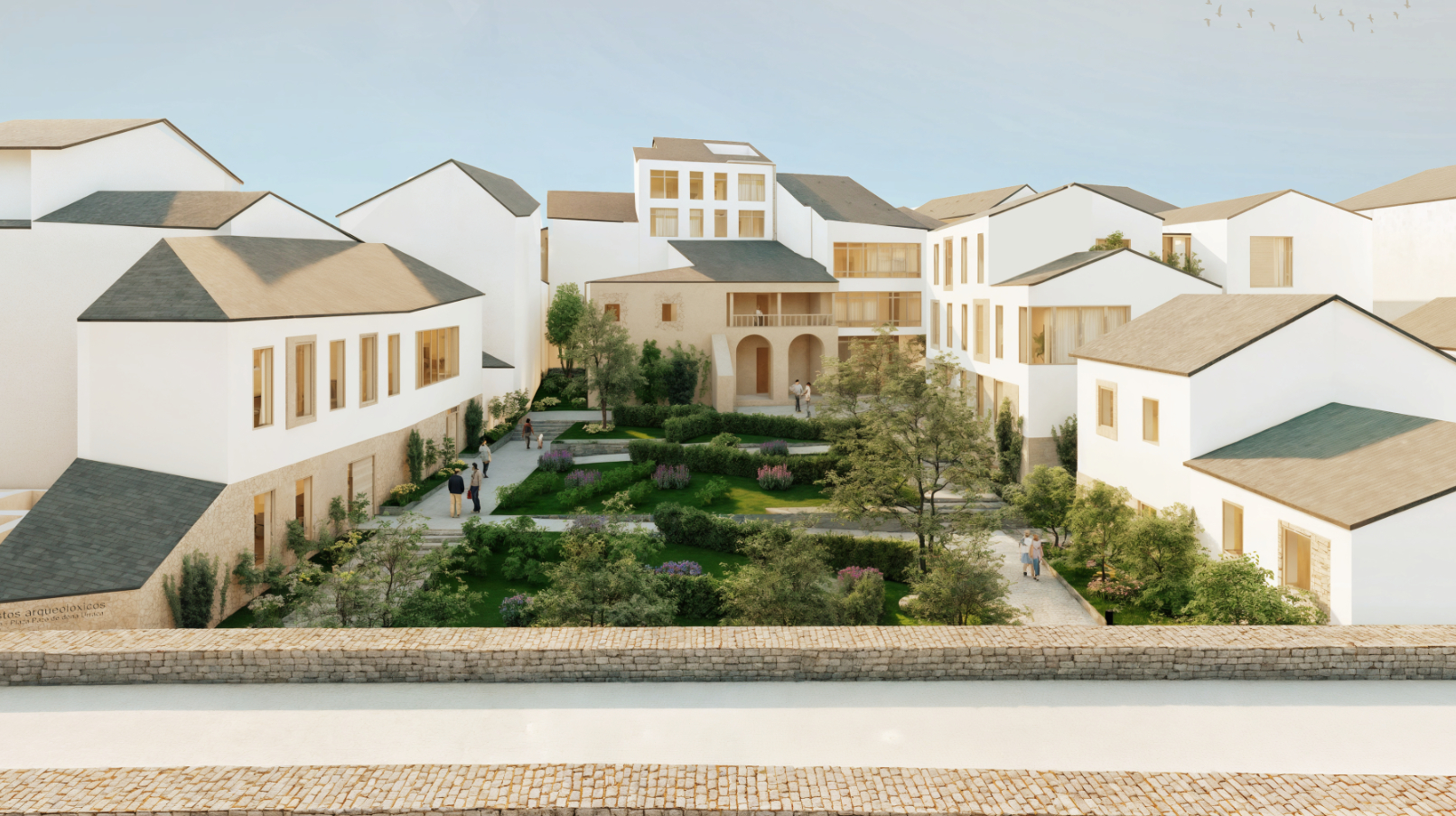
“Senda305” was born from the desire to weave a new tapestry of life in the medieval heart of Lugo, where every stone and every vestige speaks of the passage of time. This project revitalizes the Pazo de Doña Urraca and its adjacent historic facades, while incorporating contemporary buildings that keep the dialogue with Galician tradition. More than a simple renovation or expansion, “Senda305” proposes a sensory journey: a route that intertwines the public and private spheres, the archaeological and the everyday, under the ever-changing Galician light.
The newly created plaza, designed with a gentle topography, bridges the difference in elevation between Rúa do Moucho and Rúa do Miño with soft ramps that invite visitors to pause, converse, and contemplate. Its center, a garden laid out with hedges, trees, and plantings that evokes and replicates the likely footprint of buried Roman ruins. This offers a miniature woodland where visitors perceive ancient walls and pillars as if emerging from the ground. This “green archaeology” anticipates future excavations and connects, in every season, with the city’s historical identity.
On the building facade, the old structures with load-bearing walls and timber frames engage in a dialogue with new volumes: buildings AB and C (with ground-floor commercial spaces and affordable housing above), where bioclimatic design becomes livable poetry. Glazed buffer spaces act as climate lungs: shaded galleries to the west to cool the increasingly hot summers, and greenhouses to the south that capture the light and provide warmth in winter. These extra spaces, integrated into the skin of each dwelling, promote cross-ventilation and enhance interior comfort, offering views over the plaza, the manor house, and the city wall.
The rehabilitation of Miño 19-21 addresses the regulatory challenge of protected housing by incorporating courtyards and an optimized layout that guarantees excellent lighting and ventilation. The Pazo, connected to Miño Street, is freed from superfluous additions and renovations that hinder its spatial interpretation, accommodating potential exhibition spaces, and gaining a central stairwell and elevator that structures the museum intinerary.
Taken as a whole, “Senda305” fosters the urban regeneration of the A Tinería neighborhood, aligning with policies to “green the city” and with the principles of neuro-architecture and environmental and climate sustainability. Each element—the restored Pazo (manor house), the adaptable housing, the green archaeological contours, and the large, accessible plaza—merges to create an urban narrative that invites walking, learning, and a sense of belonging. Thus, this project promises not just a thoroughfare, but a vibrant heart, a bridge between historical memory and contemporary life in Lugo.